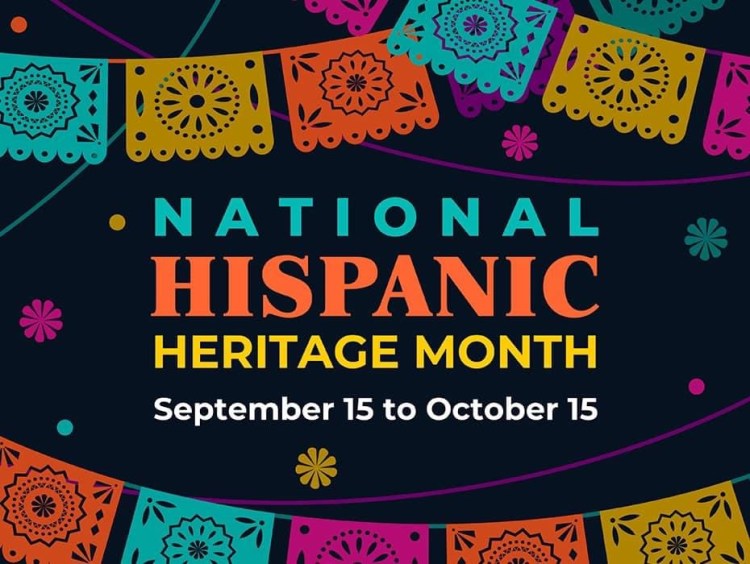
National Hispanic Heritage Month is celebrated every year from September 15 to October 15 to recognize the contributions and influence of Hispanic Americans to the history, culture, and achievements of the United States.
History
Hispanic Week was established by legislation sponsored by Rep. Edward R. Roybal of Los Angeles, California, and was signed into law by President Lyndon Johnson in 1968, taking place on the week including both September 15 and 16. In 1988, the commemorative week was expanded to a month (September 15 to October 15) by legislation sponsored by Rep. Esteban Edward Torres (D–CA), amended by Senator Paul Simon, and signed into law by President Ronald Reagan. September 15 was chosen as the starting point for the commemoration because it is the anniversary of the Grito de Dolores (early morning, 16 September 1810), which marked the start of the Mexican War of Independence and thus resulted (in 1821) in independence for the New Spain Colony (now Mexico and the Central American nations of Guatemala, El Salvador, Costa Rica, Honduras, and Nicaragua) which became the Federal Republic of Central America.
The 30-day period also includes many dates of importance for the Hispanic community: Costa Rica, El Salvador, Guatemala, Honduras, and Nicaragua celebrate their anniversary of independence on September 15; Mexico commemorates its independence on September 16; Chile commemorates its independence on September 18; and the celebration Columbus Day or Día de la Raza.
Hispanic Heritage Week was first proclaimed by President Johnson in 1968 in Presidential Proclamation 3869. Presidents Nixon, Ford, Carter, and Reagan gave annual proclamations for Hispanic Heritage Week between 1969 and 1988. National Hispanic Heritage Month was first proclaimed by President George H. W. Bush on September 14, 1989, with the Presidential Proclamation 6021. Since 1989, all Presidents have given a Presidential Proclamation to mark Hispanic Heritage Month.
Military commemorations
National Hispanic Heritage Month is a time for the U.S. Military to honor both fallen and active-duty Hispanic Americans who served in the armed forces. Sixty-one people of Hispanic heritage have been awarded the Medal of Honor, two were presented to members of the Navy, 13 to members of the U.S. Marine Corps, and 46 to members of the U.S. Army.
During the month, the U.S. Army commemorates the longstanding and remarkable contributions that Hispanics have made in building and defending the nation. As of September 2018, 136,000 Hispanic soldiers serve, composing 13.8 percent of the Army. According to the official Army website, the goal during Hispanic Heritage Month is to celebrate the diverse and inclusive environment of the U.S. Army. Through coordinated efforts throughout the Army, this observance will be used to inform Army audiences and celebrate the contributions of Hispanic soldiers, civilians, and their families. The representation of Hispanic Americans on active duty has increased by 10 percentage points during the past 30 years. In 1985, it was three percent, and by 2016 it was 13.7 percent.
The U.S. Navy celebrates Hispanic Heritage Month by honoring sailors of Hispanic heritage whose military service dates back to the Civil War. As of June 2018, approximately 59,000 active and reserve sailors of Hispanic heritage serve in the U.S. Navy and Marines.
(Adapted from the Wikipedia article with the same tittle.)
Local events
 Long Island Latino Association Inc.